Since 2004, Malcolm Koch has been mark-making on curve structures. A blending point of art and science, where our quantum world meets classical mechanics in the most human way.
Coincidentally, as it may seem, this work, which he calls Membrane Art®, conceptually aligns with some artificial intelligence (AI) art generation. Especially in its focus on transforming complex, multidimensional processes into flattened, human-perceivable 2D visuals. This mirrors how AI interprets vast data to create coherent, emergent images from underlying patterns, creating a unique aesthetic from “somewhere else”.
Both explore hidden structures (like quantum fields or data sets) to generate art that feels familiar yet alien. Showing a “compression of depth” where intricate origins yield simple, impactful final forms.
Yet, the defining difference – human touch and feel.
Malcolm Koch’s “Membrane Art” does not conceptually resemble art from standard AI platforms because its beauty is not the product of algorithmic image creation. But rather a distinct, physical process involving a human artist’s contact with curved surfaces and space itself.
Conceptual Parallels
- Multi-Dimensional to 2D Transformation
Koch uses curved surfaces (3D) to generate expressions, then flattens them to 2D, creating a unique aesthetic from the “unraveling”. AI algorithms work in high-dimensional “latent spaces” (complex data structures) and project them onto 2D screens, making abstract patterns visible. - Underlying Structures
Koch’s “membranes” and “quantum brushstrokes” are guided by scientific concepts like electromagnetic fields, creating hidden structures. AI uses underlying mathematical structures (neural network weights, embeddings) to form images, often revealing emergent, unexpected connections. - “Something Else” Aesthetic
Koch describes his marks as coming from “somewhere else,” a space where expression and sculpture unite, not bound by traditional rules. AI art often produces results that feel novel. Bridging styles in ways humans might not easily conceive, deriving from vast digital “somewhere else”. - Emergent Beauty
Both processes generate an aesthetic beauty through a transformation of depth and complexity. A new visual language emerging from the process itself, challenging perception.
Key Difference in Method, Similarity in Concept
- Method
Koch’s approach is physical and sculptural, using actual curved surfaces and paint. AI uses digital algorithms and data. - Conceptual Echo
Both artistic methods conceptually reflect how reality (or data) can be represented in forms beyond immediate human perception. With the final work acting as a flattened glimpse into a more complex reality or dataset.
“Membrane Art” does not conceptually look like art from typical AI platforms, as its aesthetic is a direct result of a unique, tangible physical process involving a human artist’s interaction with curved surfaces, rather than an algorithmic generation of images.
Key Differences
| Feature |
|---|
| Malcolm Koch’s “Membrane Art” | Typical AI Art Platforms | |
|---|---|---|
| Creation Process | Marks (paintings, cuts, drill holes, stains) are physically applied to a curved, three-dimensional surface (canvas or copper). This is then flattened for display. The curvature dictates the final, often unexpected, two-dimensional appearance. | Images are generated by algorithms that analyze vast datasets of existing images and create new patterns and compositions based on text prompts or input parameters. |
| Aesthetic Origin | The resulting aesthetic is rooted in physicality, gravity, and the unpredictable interaction of materials with a curved geometry, which the artist describes in terms of quantum mechanics and the human condition of observing a “flat universe”. | The aesthetic is based on statistical patterns and data synthesis. While complex, the process lacks the direct, physical, and often tactile origin of Koch’s work. |
| Human Element | The work emphasizes the artist’s physical, gestural response and interaction with the material in a “blind” fashion (as some marks are out of sight on the curved surface), leading to unique and often irreplicable results. | AI art can lack a deep human or personal touch, as it is motivated by data and commands rather than the artist’s personal stories, emotions, or physical interaction with a medium. |
Artist working notes
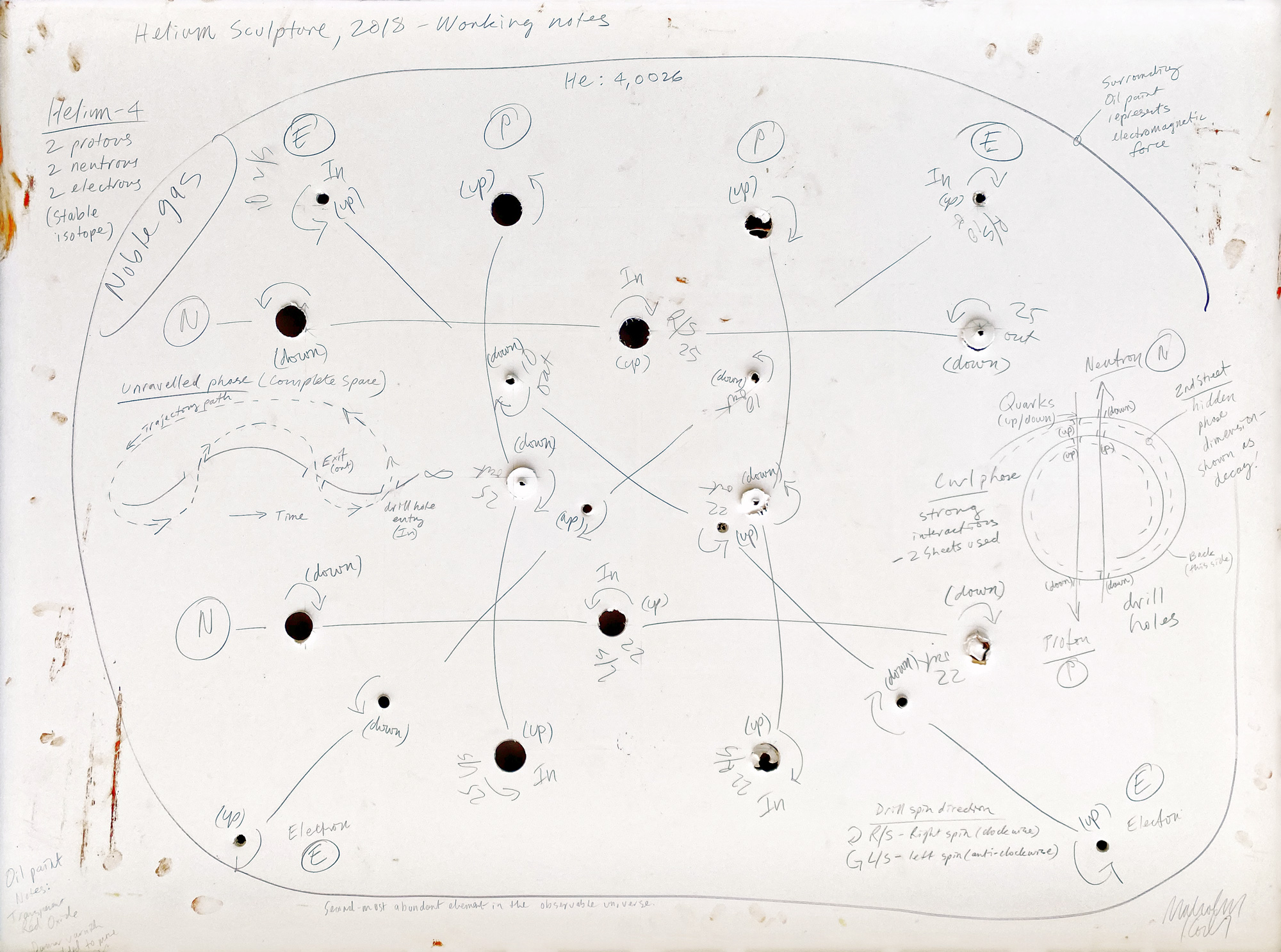
These notes below serve as a crucial guide, facilitating Koch’s navigation of space and enabling him to create aesthetically pleasing artwork from one piece to the next. They act as a roadmap, guiding him from the initial concept to the final execution of each piece.
These few examples may be self-explanatory. However, it is important to note that these notes were created for his personal reference. They serve as practical (analogue) procedures with tangible outcomes. The primary objective is not for others to comprehend them; rather, they serve as clues for the artist to achieve aesthetically desirable outcomes in his artistic journey. For instance, “In” represents the entry point, while “Out” signifies the exit point the drill holes, one complete expression or “quantum brushstroke”, which are subsequently linked up by a line. While these terms and markings may be familiar to the artist, further clarification may be necessary, if required.


Conclusion
Malcolm’s artistic style is comparable and separate at the same time. Thus, the conceptual essence of “Membrane Art” and the aesthetic results of AI seem to fit our contemporary reality when combined. Understanding how human emotions influence art enables us to recognise the profound impact artists’ works can have on our modern lives, creating pathways for empathy and connection in a chaotic world where artificial intelligence (AI) will play an increasingly significant role in the future. We need to keep in mind that human creativity has and will continue to create art that predates computational data-driven aesthetics. Finally, Malcolm’s art aims to bring a greater sense of meaning to human endeavours through the expressive touch of three-dimensional objects that cannot reside alone on a flat two-dimensional picture plane.
About Malcolm Koch’s art
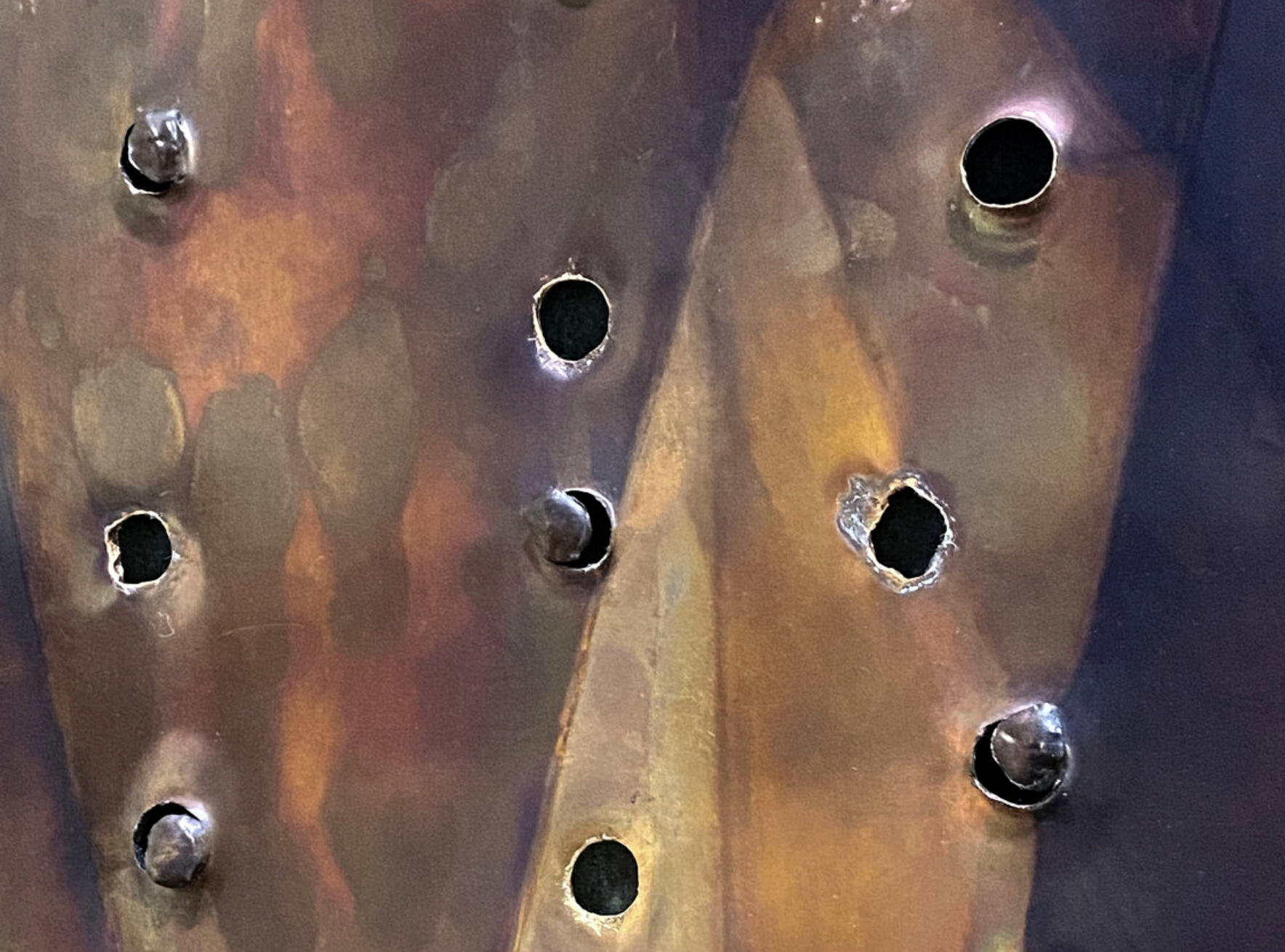
Malcolm’s abstract copper art works are in a style that he calls “Membrane Art”. A working practice that is characterised by mark makings on curved structures rather than on a flat picture plane. The surface geometry underpins the aesthetic of each piece. So the drilling, saw cuts, patina (staining) processes were all developed through the practice of allowing the curved surface geometry to play a part in creating distinctive expressions before the transformation of flattening the profile. An aesthetic thought that he has been evolving since 2004.
Malcolm’s related published art papers: “Quantum Brushstrokes,” and “Quantum Brushstrokes – exhibition notes”, published on Academia
(https://www.academia.edu/35908699/Quantum_Brushstrokes),
(https://www.academia.edu/24646040/Quantum_brushstrokes_exhibition_notes_).
More information:
Malcolm’s work has had over 20 solo exhibitions and numerous group exhibitions, including at RiAus (FutureSpace Gallery) which had two exhibitions: Visual Entanglement in 2016 and Under the Surface in 2014. His work is in numerous private and corporate collections in Australia and overseas. He has been a three time finalist in the Waterhouse Natural Science Art Prize. WNSAP–previously accepted entries, and a finalist in the Stanthorpe Art Prize, Milburn Art Prize and the South Australian Living Arts festival.